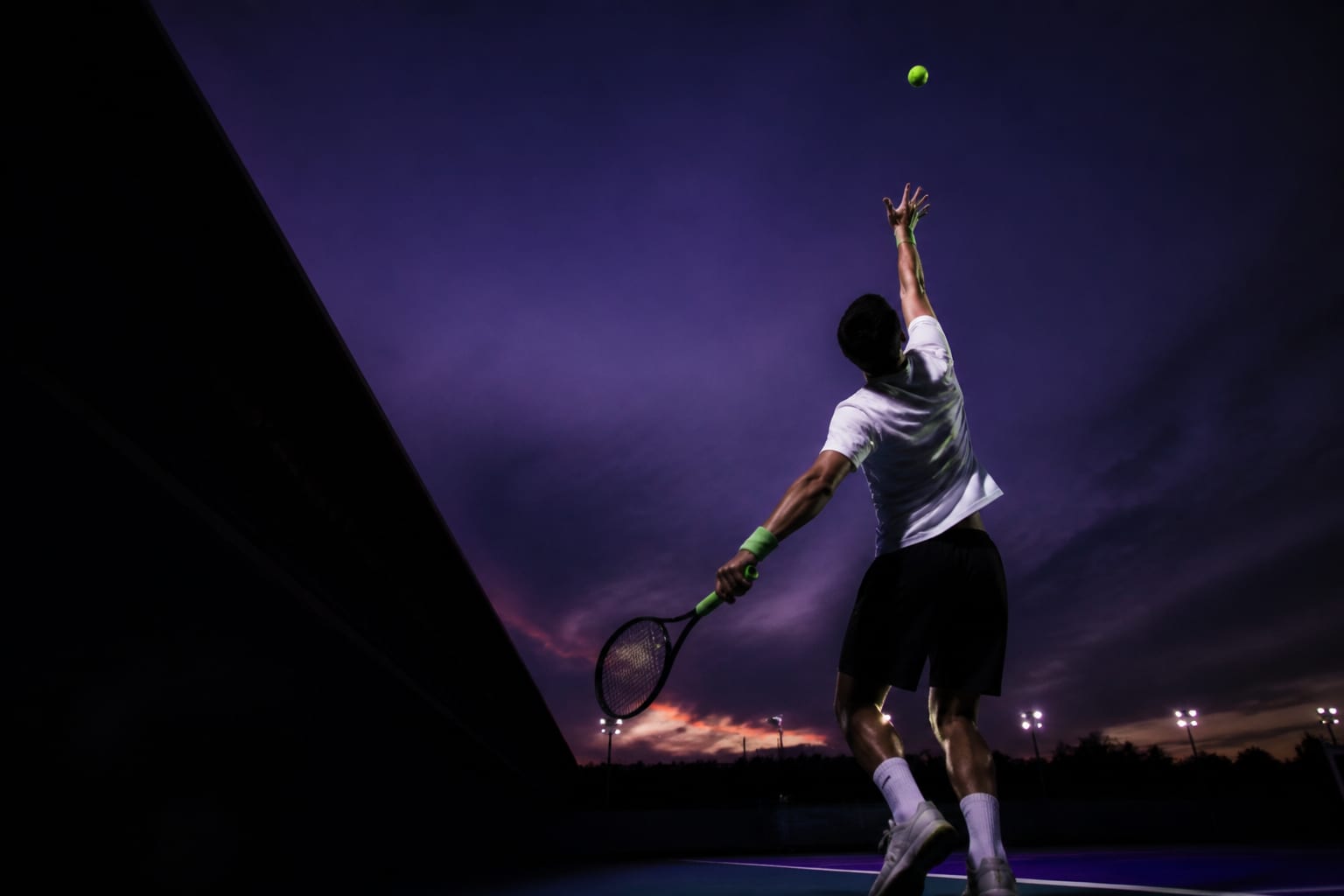
The Novak Djokovic serve has seen remarkable improvement in technique in the stroke production. In recent times, the Djokovic serve has progressed into a weapon as a result of his efforts to improve the tennis serve motion.
The Novak Djokovic serve had been a trouble spot for several years on the professional tour.
The Novak Djokovic backhand technique is hailed as one of the top two handed backhands on tour.
Recently, Djokovic's serve has seen a major improvement due to the changes in the technical motion. Just a few years ago, commentators and fans were quick to point out the problems with Novak's game and in particular, his serve.
Apparently, Novak Djokovic's serve is now a weapon as he has recently amassed much better tournament and playing results. In closer observation, Djokovic has made a few significant changes to his serve, resulting in a much more accurate and powerful serve.
Novak Djokovic's Serve: The Background
Djokovic's rise to the top of the game is inseparable from what he did to his serve. Through the late 2000s the men's game was dominated by Roger Federer and Rafael Nadal. Djokovic looked ready to turn that pair into a trio when he won the 2008 Australian Open, and then stalled rather than progressed.
It was puzzling because he seemed to have such a complete package as a player. He moved and covered the court no worse than Nadal. He hit aggressive shots and played smart tennis like Federer. But he didn't possess the Swiss man's variety and effortless grace nor the Spaniard's brute physicality and warrior-like persona. There were missing elements in his game that prevented him from taking over as the next dominant player.
The first thing he needed was to improve his fitness. He often got tired in long matches and quit when the conditions were too harsh for him to endure. He needed to be mentally stronger and not spend so much energy by being overly dramatic on the court. Technically, the Djokovic serve also needed some tweaking.
Learning Novak Djokovic's Serve Technique
The serve is the most important shot in tennis. Even with today's slower surfaces and more baseline oriented styles, the serve remains the cornerstone of every great player's game. The top players of today hit less aces the top players from about 15 years ago when Pete Sampras, Goran Ivanisevic and Richard Krajicek rained them down, especially on the fast courts.
But today's players rely heavily on the serve to set up their next shots. Nadal couldn't complete his own career grand slam had it not been for the improvements he made with his serve. The Djokovic serve was by no means weak or vulnerable. But it was not the weapon he needed it to be.
Djokovic is blessed with a 6'2'' frame that is lithe, flexible and deceptively powerful. He has an elastic quality about him that recalls Ivanisevic. To improve his serve, he didn't need to build more strength or flexibility. He just needed to modify his technique a little.
Novak Djokovic Serve Technique
The Djokovic serve begins with the line-up at the baseline. His left foot is about 45 degrees to the baseline and the right foot is almost parallel. The feet are about body width apart, but since he has a slim build, they are not too far apart. He holds the racket in a continental grip or turns it a little over to the eastern backhand grip if he's going to hit a kick serve. Novak Djokovic then bounces the ball... over and over and over again, depending on the importance of the point. The bigger the point, the more times he bounces the ball. This somehow calms him and helps him concentrate. Only then does he commence the wind up.
The Djokovic serve has similarities to the Pete Sampras serve at this point because they both point the toes of their leading foot up. Weight is loaded on the back leg. The toss is dependent on the type of spin he wants to impart. For a kick serve, he will toss more to the left and over his head, while for a flat or slice serve, he tosses more out in front and a little more to the right. The tossing arm leads the hitting arm, which begins to wind up the racket.
Novak Djokovic Serve: Wind Up
This wind up is a classic motion. He takes the racket back in a full, circular loop. He coils his hips and shoulders, almost showing his back. His legs relax and begin to push down on the ground. The take back brings the racket into the trophy position. This is one part of his serve that has changed for the better.
Novak Djokovic Serve Technique: The Big Change
In the past, his elbow was too low in this trophy position. This increased the distance his racket head had to travel to get to the contact point, theoretically allowing him to build up more speed. But it wasn't biomechanically efficient. It required too much effort. It also compromised the consistency of the swing and therefore the accuracy of the resulting shot.
Djokovic Serve: His New 2011 Serve Motion (Left) Vs. the Old Tennis Serve Motion (Right)
The 2011 version of the Djokovic serve has his elbow in a slightly higher position on the take back. His arm and shoulder are now in better alignment with his tossing shoulder and arm. At the end of the take back, his knees are bent more deeply.
Novak Djokovic Serve: Uncoiling to the Upwards Swing
The next phase of the Djokovic serve is the uncoiling of the body as he launches up to hit the ball. The feet push off as the knees begin to extend up and propel him to the ball. The hips uncoil, and this is another part of his motion that has improved. He used to remain a little sideways on throughout the stroke. This broke the kinetic chain that was supposed to lead all the way up to the racket whipping through the ball. Instead, he had to rely on his shoulders and arm more to generate power.
Today, he uncoils from the hips more resulting in an overall increase in the fluidity of the stroke. He still doesn't uncoil as much as someone like Roger Federer, so maybe there is still more room for improvement with regards to this stroke. After the hips, the shoulders uncoil and the elbow goes up while the wrist remains cocked and ready to whip at the ball.
Novak Djokovic Serve: Contact Point
When the ball is in striking distance, Djokovic extends his elbow and starts to pronate the wrist. On a flat serve, he will hit right through the ball. On the slice, he will come around the right side of the ball while still going through it. Kick serves are hit from 8 o'clock to 2 o'clock position - exactly as any tennis instructional material would say. In any case, his arm is fully extended at the point of contact.
The follow through also depends on the type of spin he has put. However, there is less of a pronounced difference between his follow through on the kicker compared to the flat or slice serve. Other players follow through their kick serves on the same side of the body. Djokovic follows through ahead of him because he hits more through the ball even on this kind of serve. In the past, this relatively flatter way of hitting the kick serve resulted in a number of crucial double faults.
Novak Djokovic Serve Technique: Recovery Position
The last part of the Djokovic serve is the finish and recovery. He lands well inside the court with his chest almost parallel to the ground and the right leg extended almost fully behind him for proper balance. His quickness and rubber-like snap back to the ready position means he can handle any kind of return. Two of his biggest rivals, Nadal and Andy Murray, count their returns as some of their best shots. During his 2011 season he won every match he played against those two.
Djokovic Serve Potential in the Future
The vast improvement of the Djokovic serve, along with the exponential increase in his fitness level and confidence has resulted in an almost unbeaten 2011 season. He has won the Australian Open and Wimbledon crowns to cement himself as the new number one ranked player. He has compiled a 49-1 win-loss record, the lone loss coming against Federer at the French Open.
The US Open is the next big tournament coming, and chances are, he will walk away with his third grand slam title of the year. He was runner up there last year to Nadal, and he was still using his old service motion. Nadal's win was keyed also by improvements to his own serve. It seems like history is destined to repeat itself - not because Nadal will win again, but because a player with a new and improved serve will again lift the championship trophy in New York.
Common questions
How does he line up at the baseline?
Left foot about 45 degrees to the baseline, right foot almost parallel to it. That combination sets up the turn without over-rotating the stance, so the coil comes from the body rather than the feet.
What kind of wind-up does he use?
A classic one. A full circular loop taking the racquet back while the hips and shoulders coil almost to the point of showing his back, with the legs relaxing before they load.
What was the significant change he made?
Raising the elbow at the trophy position. It had been too low, which lengthened the distance the racquet head had to travel to reach contact and cost both speed and consistency.
Is the serve still decisive on slower courts?
Yes. Even with slower surfaces and more baseline-oriented play, the serve remains the shot every point is built on. It is the one ball nobody can influence but you.