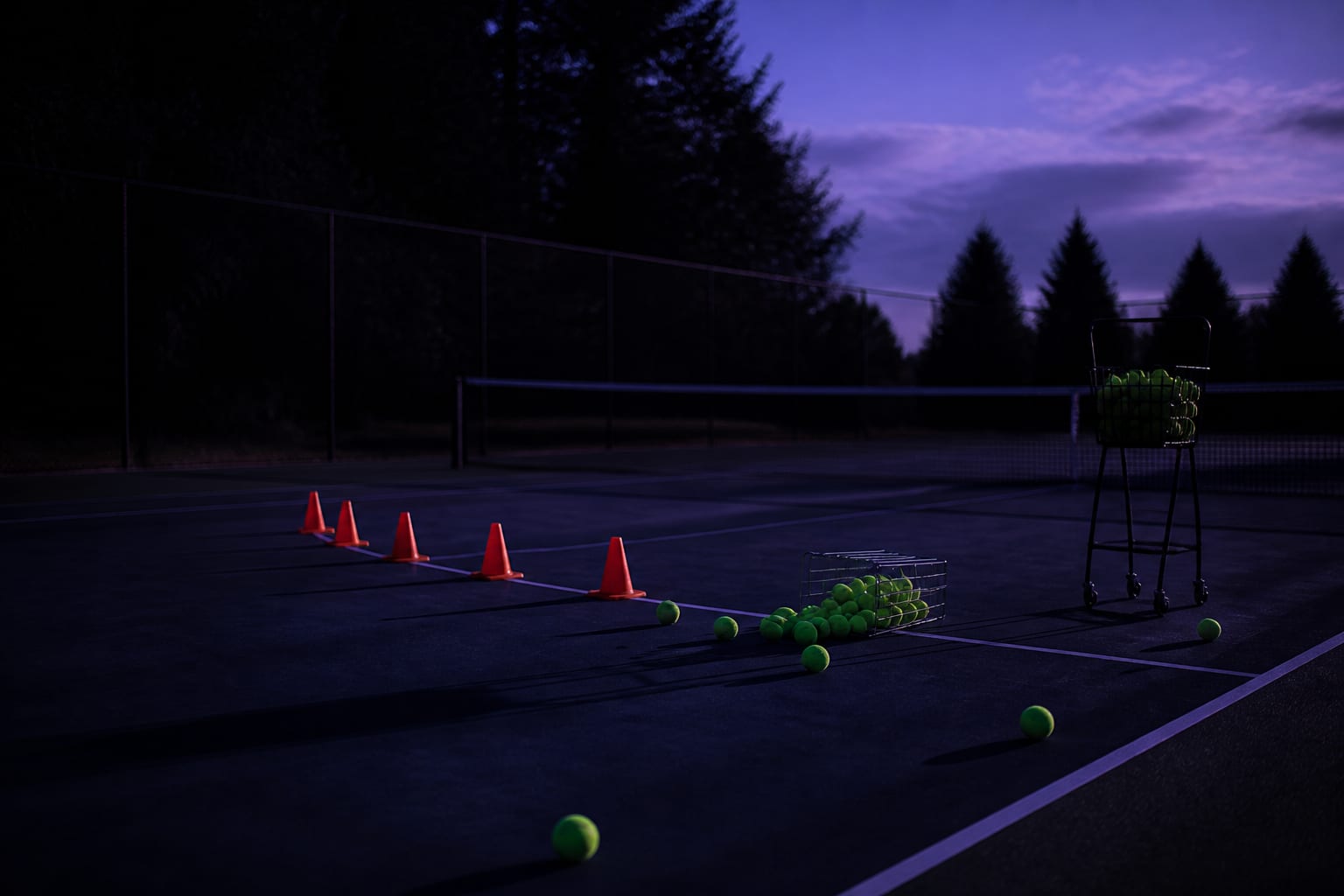
Watch a professional practice session and the first surprise is how little of it looks like match play. The rallies are longer, the pace is lower than expected, and a great deal of the time is spent on shots that will be played four or five times in a match. Federer's sessions were widely filmed over a long career, and what they show is mostly repetition of unglamorous things.
What the footage actually shows
Long cross-court rallies at controlled pace, hit to a target rather than for winners. Extended blocks on a single shot. The inside-out forehand, the slice backhand, the approach, repeated well past the point where a club player would have moved on. Serve sets hit to specific boxes rather than for speed. And a large proportion of time spent moving without hitting at all.
The pace is the part that reads as counterintuitive. Practice rallies are struck with margin, because the purpose is a repeatable stroke rather than a won point. Hitting at match intensity in practice produces fewer repetitions and worse ones.
The straight-arm forehand, and why copying it rarely works
Federer's forehand is hit with the hitting arm extended rather than bent, which is unusual and much imitated. It is also a consequence of his grip and contact point rather than a technique that can be added to a different forehand. A player using a more Western grip who straightens the arm loses the contact point that made it work, and the shot gets worse.
This is the general problem with modelling a stroke on a specific player. What transfers is the relationship between grip, contact point and swing path. What does not transfer is any single element lifted out of that relationship.
What does transfer
Three things, and none of them is a stroke. The unit turn happening early. The shoulders and hips rotating before the ball has crossed the net, not as it arrives. The recovery step being treated as part of the shot rather than something that happens afterwards. And a relaxed grip pressure between shots, which is what allows the fast, loose swing that produces racquet-head speed without effort.
All three are visible in footage, all three are unglamorous, and all three are available to a club player without changing their technique at all.
Practice structure, not practice content
The more useful lesson from professional sessions is organisational. Blocks are long, goals are narrow, and a session usually addresses one or two things rather than everything. A club player who spends an hour hitting a bit of everything has practised nothing; the same hour spent on cross-court backhands to a target changes something.
Watching footage productively
Practice video is more instructive than match highlights precisely because it is repetitive. A highlight shows a shot that worked once; a practice block shows the same shot forty times, which is where the pattern is visible. For anyone studying footage seriously, the notes on filming and frame rate apply to watching as much as to recording, look at sequence and timing rather than at single frames.
What is missing from the footage
The parts of a professional's preparation that are not on a court, and they are most of it. Gym work, movement preparation, treatment, and the volume management that decides how much hitting is possible in a week. Practice video shows the hour that films well and omits the four that do not, which is why it reads as though professionals simply hit more balls than everyone else.
Why the sessions look easy
Because they largely are, by design. Practice intensity below match intensity produces more repetitions with better technique, and the point of a practice block is the repetition. Players who practise at maximum effort accumulate fewer good repetitions and more fatigue, and the technical change they were working on does not survive into the next session.
This is the most transferable observation available from any professional footage, and the one club players most consistently ignore.
Common questions
What is surprising about watching a professional practise?
How little of it resembles match play. The rallies are longer, the pace is lower than expected, and the balls are hit to a target rather than for winners.
Why does copying the straight-arm forehand rarely work?
Because it is a consequence rather than a technique. Federer's hitting arm extends because of his grip and contact point; adopting the extension without those produces a different shot entirely.
What actually transfers from professional practice?
Three things, none of them a stroke: the unit turn happening early, shoulders and hips rotating before the ball crosses the net rather than as it arrives, and the organisational habits around it.
Is practice footage more useful than highlights?
Yes, precisely because it is repetitive. A highlight shows a shot that worked once; a practice block shows the same shot thirty times, which is where a pattern becomes visible.
What is the organisational lesson?
Long blocks, narrow goals, and one or two objectives per session rather than everything at once. The structure is copyable at any level even where the content is not.